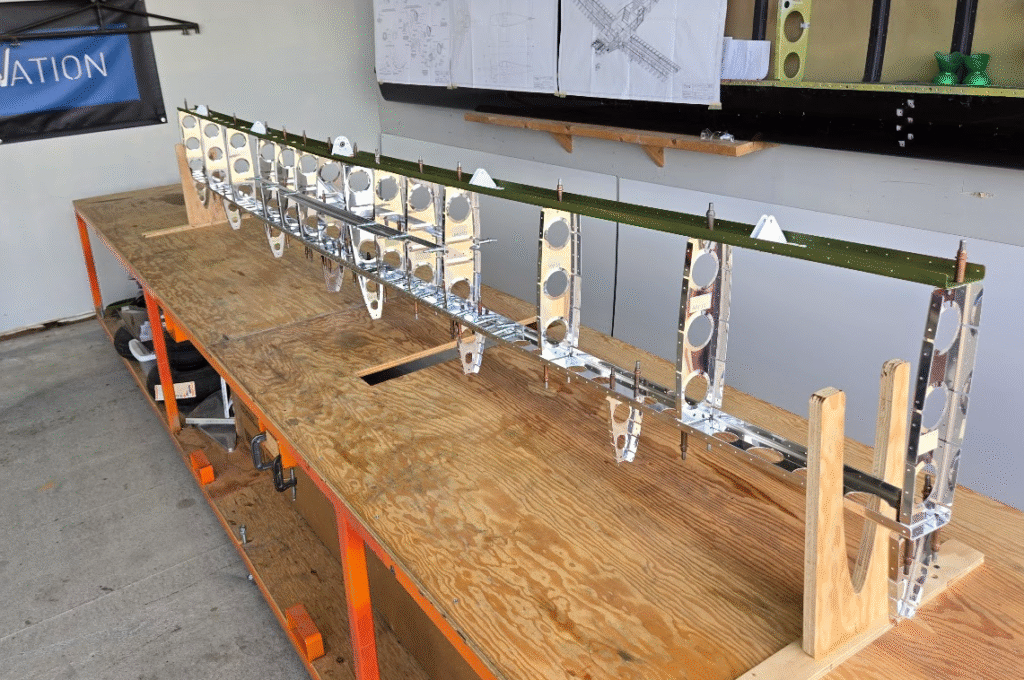
We still don’t have the backorder-stock-screwup rudder skin, or the replacement Vstab rear spar, so today’s forward progress forcused on the Hstab and eventually, the elevator.
But first, the RV14 skin mistakenly sent by Vans had to be boxed up to be sent back. This took a lot longer than I was expecting, and I think I owe Ephraim a new roll of tape after needing to “fabricate” a new cardboard box for it, but in the span of a big project like this, mistakes happen and it’s not blocking us (yet) so not a big deal.
While I was practicing sheet metal work on cardboard, Ephraim was setting up the next steps. As soon as I was done, he handed me Scotchbrite and a stack of Hstab parts with instructions on how to clean them (Scotchbrite + acetone) up in prep for priming. It didn’t take too long for me to have the parts clean, and Ephraim gave me a primer (lol) on shooting primer.
It’s not enough to be taught how to do these types of tasks. Having an experienced set of eyes to look at things and say “yeah that looks right” or “this needs more work” is incredibly valuable. I can’t say enough good stuff about a build assist service like what Ephraim offers. I think if I were to try to complete this project on my own, I’d be really slowed just trying to work out if I was completing the various tasks correctly. Judging if the priming layer is thick enough is one example of such a situation.
I spent the next few hour or two cleaning and priming parts.
With the freshly primed parts curing, Ephraim announced it was time to start the elevator, which meant a return to my now-cemented routine of removing blue wrap, marking PNs in sharpie, covering the PN with tape (to mask for prime), and deburring.
Not that any of the work on this project is unrewarding, but some tasks are more rewarding than others. Riveting the primed (and now dry) Hstab forward spar doubler assembly was a rewarding way to end the day.
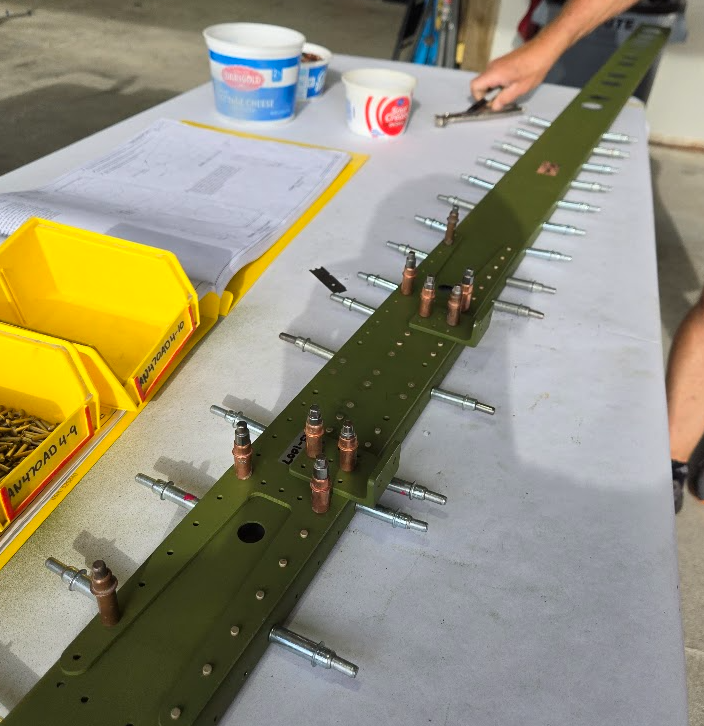
…I also ordered more shit.
About the yaw damper: Yes, adding another servo is more weight, more complexity, and more cost, but I put real thought into this and I believe this to be a good trade. The stock RV10 plans do not include rudder trim. People solve this issue in a variety of ways: rudder wedges, spring based control cable bridal setups, or the Aerosport spin driven rudder pedal trim. I’m not a huge fan of any of those solutions.
The Aerosport spring system requires that their wind up box can be mounted in a compatible location. I haven’t planned my panel yet, and I’m not sure if I will have such a location. For any other spring based system, there is some offroading required since there is no other off the shelf solution. I am really trying to avoid this airplane becoming a science fair project, so developing a custom (probably tail cone mounted) spring trim mechanism seems to stray too far in that direction.
Wedges are simple and do work, but they only work at one airspeed. The airplane may sit slightly uncoordinated outside of that point in the envelope.
The function of the a yaw damper is primarily to counter yaw transients due to inherent yaw instability. I want to emphasize that I understand that yaw damping is not the same as yaw trim,. *That said*, it seems to be the case that if minimal control input is required, the Garmin yaw damper will also try to coordinate the airplane. See this topic on VAF, especially page 2.
The proof is in the pudding:
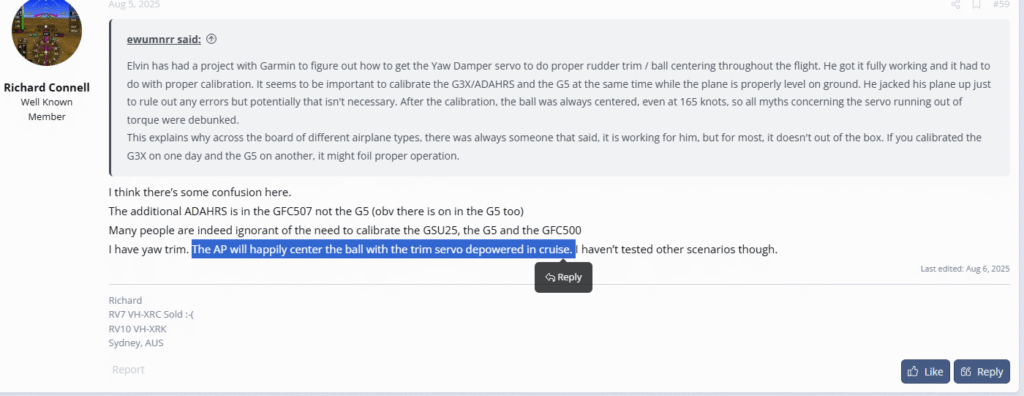
This is one of **several** pilot reports that the Garmin YD will try to center the ball.
I have been very careful in verbiage while writing the above. I have specifically mentioned the behavior of the Garmin YD because this isn’t necessarily something any other YD will do. Again, the main purpose of YD is to stabilize an airplane which is inherently slightly unstable in yaw. That said, many mechanisms referred to as “yaw damper” also include functionality to try to coordinate. I have seen similar pilot reports suggesting the Dynon YD will also try to center the ball.
Back to 21X. I like the idea of the actual YD functionality for backseat pax comfort, but what I’m really after is the coordinating tendency of the Garmin YD controller. It seems that all one needs to do is get the rudder trim “close enough” to perfect for the Garmin YD to take it the rest of the way. For that problem, a rudder wedge is almost certainly the right solution.
In summary, my rudder trims solution for 21X is a wedge + Garmin YD.
About the Bob Archer antenna: It seems like builder reports actually suggest this antenna works well enough in the RV10. I do fly plenty of single pilot IFR, however it tends to be pretty rare for me to use VOR based navigation or even ILS approaches. I think the probability of me needing to track a VOR enroute is essentially zero, which is probably the weak performing scenario for this antenna. I’m trying really hard to keep 21X clean, and having a typical nav antenna sticking out all the time for being used .001% of the time just bugs me. My plan is to establish the limitations of this antenna in flight test, and if they are found to be unacceptable and unfixable to shoot an ILS, I’ll revist this and probably install a normal nav antenna. On the other hand, if it works well, I’ll probably buy another for the other wingtip and wire it to the other nav radio.